

Latest Event
 |  |
|---|---|
 |  |
 |  |
 |
Imperial Predator
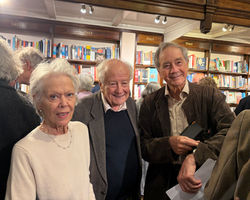
Some words from the balcony in Daunt Books, 13 October 2026
Many thanks to all of you who came; to Michael Dwyer, whose idea it was; to Alice Clarke, so constructive; and to Sinan Kuneralp, so rich in his ideas.
The book is dedicated to three people who could not be here - my son, Oliver, and to Patricia & Timothy, with whom I travelled so much of Turkey. Would that Christopher Roper too could have seen how it all ended.
The book?
Much has been written about the collapse of the Ottoman Empire, and much of it has focused on the First World War. Gallipoli, Kut al-Amara, and, so fatefully, Palestine.
That language and focus are distorting. Collapse implies a terminal crumbling from within. But the Ottomans’ main problem was abroad. They had a superb geo-strategical position and rich resources. Europe was expanding, using its technologies of violence to conquer the world. In their fevered competition, the Europeans’ rationale was to consider the rest of the world terra nullius, a land without inhabitants, thus nullifying the rights and customs of native and indigenous peoples.
In the New World, the United States applied this same approach to the 10 million or more inhabitants of north America, and later to the Philippines.
In the Old World, Britain was particularly successful in the plundering of the Ottomans, taking over three-fifths of the land they lost after 1876. But Russia, France, Italy, Austria-Hungary, the Slavs and the Greeks joined in. Only Germany stood back, focussing instead on gains from finance and arms trade. And, of course, railways.
Shifting the focus back to the 1870s introduced me to those Victorian grandees, Salisbury and Gladstone. The Liberals wanted to reverse Salisbury’s filching of Cyprus, but then presided over the invasion of Egypt. Five years earlier Gladstone had written that seizing Egypt ‘would end forever the realisation of that lofty aim, the founding not of a terrestrial but moral empire’. Yet that is what happened, a tale not of government planning but of hubris, face, and two men imbued with, as a Calcutta paper wrote ‘the self-righteousness and immeasurable self-esteem which constitute the foundation of the national character’.
Britain tried to get rid of Egypt on 66 occasions and failed. But, holding Egypt, it no longer needed Constantinople. Russia could have control of the Straits in exchange for being our ally against Germany. That was Grey’s policy in 1907, and with the Triple Entente Britain had no place for an alliance with the Ottomans. Thus the divisions of the First World War.
The Ottomans were no walk over. For at least two years their troops, though less well equipped, were far better commanded than were the British. Gallipoli and Kut al Amara, the first two battles of Gaza – British officers were crass. And the Royal Navy suffered too. Of the eleven major battleships lost in the whole war, five were sunk by the Ottomans.
What costs. Killed, wounded, sick – Britain and the empire suffered 2.2 million of these in fighting the Ottomans, scrambling to deploy troops equivalent to 40 per cent of those fighting the Germans in Europe.
All this increased Britain’s war costs by half. Such massive sums sapped Britain’s inherent strength, but were masked by the Empire being able to colour most of the Middle East pink. A new terra nullius. A lasting legacy of local catastrophe.
It is an awesome story.
Past Events
Lahore Literary Festival
21-23 February 2025


Lahore, Pakistan
Spectacular days with Razi Ahmed and his team, sharing their energy and Lahore's passion for creativity. From La Conquista through medieval architecture (Diana Darke, Islamesque) to AI and climatic dystopia, great speakers were conjured onto stage, most memorably Peter Frankopan.
There is hope yet.
David
The Enduring Hold of Islam Launch Party, 2024


Waterstones, Trafalgar Square, 19 September 2024
What a stellar evening. I thank all of you who came so much, and in particular Michael Dwyer of Hurst and his team.
It was good to have other publishing friends present, in particular Francis Bennet of Marble Hill Publishers and Barnaby Rogerson of the fine Eland Publishing. And some great authors – James Buchan, Christopher de Bellaigue, Philip Mansel, Brendan O’Malley, Donald Rayfield, Malise Ruthven (long an exemplar for me) and Sir Peter Westmacott.
Also some of the scholars on whose work I have drawn, not least Fulya Atacan, William Hale and Mina Toksöz – as well as Şerif Mardin’s son, Osman. And friends from over the years and my dear family.
David
Courtesy of Garry Rigby of Hardy Global
Kremlin's Confidant Launch Party, 2024


Daunt Books, Holland Park, 20 June 2024
Thank you so much to all of you who came for a bustling summer evening.
We toasted Martin Packard, whose health kept him away, and his long-time mentor in Russia, Michael Filippov, who had come to London for the launch originally scheduled on June 3, but delayed by late arrival of the books. Also Sophia Rossovsky, Martin’s interpreter, who had flown from New York for the original date.
So good to see so many long-missed friends.
David
With Oliver at the launch at Daunt Books, Holland Park
